
Mahadev Temple in Goa





Sri Mahadev Temple, Tambdi Surla
During the reign of Kadambas, in the 13th century, the Goan territory thrived in all directions due to benign administration of the enlightened rulers. Several temples were built for all the gods of Hindu Pantheon, like Nageswar, Vithal, Santadurga, Mahalaxmi (also spelt as Mahalakshmi), Ramnath, etc. Unfortunately, most of them were razed to ground by the aliens, who are aliens to culture and refinement. After more than 400 years of darkness, some of the surviving shrines opened their doors to carry on activities for public benefit.On account of foreign impact, many temples seem to be putting on a veneer of western civilisation, but deep examination shows, that the core of Hindu culture remained untainted, immaculate and dynamic.
Keeping Intact The Hindu Cultural Heritage
In the temples renovated or built afresh, as in the past, "Agamic Puja", with all rituals, is being conducted demonstrating that the much-adorned Hinduism has not lost its vitality, nor has bartered away its glory during the foreign rule. The Mahadev temple at Tambdi Surla where ancient traditions are followed serves as an example to this.
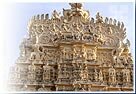
Situated in West Goa, the Mahadeva Temple in Tambdi Surla is the state's only prominent reminder of the pre-Portuguese temple architecture. Maintained by the ASI (Archeological Survey of India), this 12th century temple boasts of some fine relief's on the 'Shikhara' (spire) depicting a plethora of gods and goddesses.
It was built in the Yadava style of architecture with all the necessary parts, like Garbha Griha, Mukhamandapa, Mini-shrines, etc. and presents an extremely grand look. Do not miss the impressive carved wall near the entrance, and the chiselled monolith pillars.
 |
Architectural Style
Yadava Style Architecture Style
How To Get There
By Road
The temple site lies 69-km off Panaji, in the Sangham Taluk at the feet of the Western Ghats and is accessible by four wheelers.
General Information
Location
Tambdi Surla, 69-km From Panaji, Goa.
Deity
Lord Shiva.
Origin
12th Century.
Prime AttrACTIONs of Panjim
At the place where two of Goa's famous rivers meet the Arabian Sea is the secluded bay of Dona Paula with a fine view of the Marmagao Harbour. more..Built in 1602, the only ruin of the Church of St. Augustine on the Holy Hill at Old Goa near the Nunnery, is a lofty 46-metre high tower defying the torrential rains. more..
About 2-km on the main road towards Ponda, a Kuchcha road branches off to a place where a cross is fixed. The road leads to a hill on which, commanding a picturesque view, is the Chapel of Our Lady of the Mount more..
In the Holy Hill, on the way to the Church of Our Lady of the Rosary, is a huge three-storeyed building of laterite which was originally lime-plastered but is now plastered with cement. more..
Not far to the west of the Basilica of the Bom Jesus is the Holy Hill at the extremity of which is the Church of Our Lady of the Rosary. more..
To the west of the Se Cathedral is the former palace of the Archbishop that connects the Se Cathedral to the Convent and Church of St. Francis of Assisi. more..
It is built of laterite plastered with lime mortar, with tiled roof supported by wooden rafters is a plain chapel with only one altar. more..
Aguada Fort, which crowns the rocky flattened top of the headland, is the best-preserved Portuguese bastion in Goa. Built in 1612 to protect the northern shores of the Mandovi estuary from Dutch and Maratha raiders more..
The museum has been functioning since 1964 in the abandoned convent of St. Francis of Assisi and is maintained by the Archaeological Survey of India (ASI). The collection consists of Brahmanical sculptures hero-stones and sati stones of the early and late medieval periods, portraits, coins and currency, revenue and court fee stamps, wooden and bronze sculptures and armoury of the Portuguese period. more..
The Museum of Goa is housed at a new Building at the Patto Plaze near the Ourem creek, Panaji. The most noteworthy feature of Panjim's State Archeological Museum is its imposing size, which stands in glaringly inverse proportion to the scale of the collection inside. more..
Up in the lush foothills of the Western Ghats, Bondla is good place to see Sambhar and Wild Boar. It is smallest of the Goan Wildlife Sanctuaries. Its area is 8-sq-kms but easiest one to reach. more..
On the way to Dona Paula, 1-km ahead of the confluence of the Arabian Sea and Mandvi River, under the palm shade, is "Gasper Dias" or Miramar Beach and is just 3-km away from the capital city of Panjim. more..
The Portuguese Viceroy Redondo commissioned the Se, or St. Catherine's' Cathedral, southwest of St. Cajetan's, to be "a grandiose church worthy of the wealth, power and fame of the Portuguese who dominated the seas from the Atlantic to the Pacific". more..
3-km away from Banastari Bridge on Panaji-Ponda Road is situated the noteworthy temple dedicated to Devaki Krishna at Marcel. The deity is said to have been brought from Chorao in Tiswadi to Mayem in Bicholim and then shifted to its present place during the days of religious persecution by the alien rulers. more..
The temple tour can be resumed by offering prostrations unto Goddess Mahalakshmi, the presiding deity of Panaji, the capital of Goa. The main temple has been reconstructed recently. The main festivals at this temple are Navaratri and Chaitra Purnima. more..
As one tries to return to Panaji from Harvalem, one can visit the famous temple of Sri Saptakoteshwar Naroa, Bicholim. Sri Saptakoteshwara was the patron deity of the Kadambas who had built a beautiful temple dedicated to this deity at the Diwar Island. more..
From Kansarpal one can proceed to Sanquelim, the hometown of the Ranes of Satari who played key role in Goa's freedom struggle. The ancestors of the present Rane family, who are believed to have migrated to Goa from Udaipur about 600 years ago, built the famous Sri Vithal temple situated on the bank of Valvanta River. more..
Further to the west of the Church of St. Francis of Assisi is the chapel of St. Catherine. Built of laterite blocks it has a tower on either side of the façade. The chapel in the interior, having only one altar is plain more..
Opposite the Se Cathedral, beyond the road is the large and beautiful church of St. Cajetan built of laterite blocks, which were lime plastered. more..
Nothing remains of the Church of the Carmelites excepting the façade and a raised pavement, which served as an altar. Its location is to the southeast of the Church of St. Cajetan more..
Situated to the east of the tower of St. Augustine it is a plain looking building constructed in the beginning of the 18th century. The convent was abandoned in 1835. The Society of the Misericordia occupied it for some time. more..
On the southern outskirts of Old Goa is a hill on which stand this convent and church. more..
Immediately to the south of the main road is the Professed House, a two-storeyed laterite building covered with lime plaster. Despite the opposition, which the Jesuits faced, the building was completed in 1585. more..
To the west of the tower of St. Augustine is the Royal Chapel dedicated to St. Anthony, the national saint of Portugal and held in great veneration by the Portuguese. It was built in the beginning of the 17th century. more..
Condolim Beach
Four or five years ago, Candolim, at the far southern end of Calangute beach, was a surprisingly sedate resort, appealing to an odd mixture of middle-class Bombayites, and Burgundy-clad Sannyasins taking a break from the Rajneesh Ashram at Pune.
Hotels & Resorts in Goa |
|||||||
more goa hotels...
|
more goa resorts...
|
||||||
|
|
Suggested Tour Packages
Tour Code: GTT - 002
Duration: 4 Days / 3 Nights Destinations Covered: Mumbai - Goa |
 |
||
|
|
|||
Tour Code: GTT - 003
Duration: 8 Days / 7 Nights Destinations Covered: Mumbai - Goa |
 |
||
|
|
|||
Tour Code: GTT - 004
Duration: 10 Days / 9 Nights Destinations Covered: Trivandrum - Kovalam - Kanya Kumari - Vattakottai - Kovalam - Varkala - Cochin - Goa |
 |
||
|
|
|||
| » Other Goa Holiday Packages | |||


North India Tour with Goa
Rajasthan Heritage with Goa
Goa Travel Package
Goa Beach Holidays
Goa Beach Vacation
Romantic Goa Honeymoon
Goa Tour Package
Travelling in Goa
Goa Vacation
Goa Trips
Goa Vacation Package
Goa Beach Tour
Rajasthan Heritage with Goa
Goa Travel Package
Goa Beach Holidays
Goa Beach Vacation
Romantic Goa Honeymoon
Goa Tour Package
Travelling in Goa
Goa Vacation
Goa Trips
Goa Vacation Package
Goa Beach Tour
... more Goa Tour Package
Goa Luxury Hotels
Hotel Taj Exotica
The Leela Palace Hotel
Bambolim Beach Resort
Majorda Beach Resort
Cidade De Goa
Hotel Taj Exotica
The Leela Palace Hotel
Bambolim Beach Resort
Majorda Beach Resort
Cidade De Goa
...more Luxury Hotels
...more Deluxe Hotels
Goa Budget Hotels
Alor Holiday Resort
Anjuna Beach Resort
Dona Paula Beach Resort
Resorte De Goa
Don Jóao Resort
Goa Guest Houses
Alor Holiday Resort
Anjuna Beach Resort
Dona Paula Beach Resort
Resorte De Goa
Don Jóao Resort
Goa Guest Houses
...more Budget Hotels
...more Goa Heritage Hotels
...more Resorts in Goa
Goa Boutique Hotels
Banayan Tree Courtyard
Devaaya Ayurvedic Spa
Montego Bay Beach Village
Vainguinim Valley Resort
Banayan Tree Courtyard
Devaaya Ayurvedic Spa
Montego Bay Beach Village
Vainguinim Valley Resort
...more Goa Boutique Hotels
...more Goa Hotels
...more South Goa Hotels


|
Plan a Tour
|
 |
Book a Hotel
|
...more Goa Beaches
...more Goa Churches
Others
...more Travel Guide
...more Things to Do
...more Travel Guide
